Integration News — Special Report
Executive Summary
This newsletter introduces the Sterling Operational Efficiency Suite — a transformative layer of visibility, control, and automation for IBM Sterling Data Exchange environments. Designed to eliminate blind spots and reduce technical complexity, the suite empowers operational teams to manage data exchange with precision and confidence. By proactively monitoring certificates,
streamlining SFTP collection, and enhancing EBICS routing, it shifts operations from reactive troubleshooting to predictive control. The result is faster resolution times, reduced risk in financial communications, and improved audit readiness. For organisations seeking to optimise their Sterling platforms, this suite represents a decisive step towards resilient, transparent, and cost-efficient operations.
1. Introduction
In environments based on IBM Sterling B2B Integrator, many capabilities are designed from a technical perspective. Sterling Operational Efficiency Suite introduces a different approach: focused on real operations, continuous visibility and effective control.
- 100% operational approach, aligned with support, IT and business teams.
- Rapid implementation with no impact on existing flows.
- Ready-to-use solutions with no need for complex development.
- Unified view of processes, integrations and certificates.
- High adoption without the need for specialised training.
2. Solutions
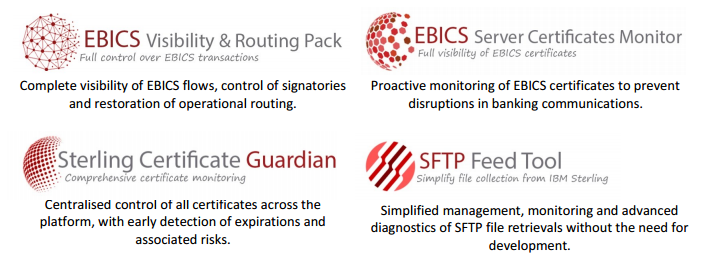
3. EBICS Visibility & Routing Pack

In EBICS environments based on IBM Sterling B2B Integrator, transaction information and traceability are often highly fragmented.
There is no unified operational layer that provides an end-to-end understanding of what happens in each EBICS transaction.
This leads to a heavy reliance on expert knowledge, resulting in a loss of operational control over critical financial processes and a significant increase in incident resolution times.
EBICS Visibility & Routing Pack is a solution designed to improve the visibility, control and traceability of EBICS transactions in environments based on IBM Sterling B2B Integrator.

3.1. The problem
EBICS operations in IBM Sterling are characterised by:
- Information scattered across multiple screens and modules.
- Lack of end-to-end traceability.
- Manual correlation between events and processes.
- Limited visibility of signatories.
- Dependence on expert knowledge.
- Slow incident resolution.
Operational teams are forced to work with fragmented information and manually reconstruct the actual status of each transaction.
3.2. Impact on the business (what happens without the solution)
This operating model has a direct impact on efficiency and control:
- Long operational recovery times.
- Difficulty in auditing and resolving incidents.
- Risk of human error and incomplete diagnostics.
- Lack of effective control over authorisations.
- Operational bottlenecks.
- Direct impact on SLAs and relationships with banks and partners.
Overall, the organisation operates with only partial visibility of critical processes, which limits its ability
to respond and exercise control.
3.3. The Solution
EBICS Visibility & Routing Pack introduces an operational layer on top of IBM Sterling B2B Integrator that transforms EBICS transaction management into a centralised, traceable and visual model.
The solution provides:
- Unified and immediate view of the entire transaction.
- Full tracking of the lifecycle of each order.
- Automatic and visual correlation of events and executions.
- Full access to all signatories of each transaction.
- Simplified access to information for any user profile.
- Rapid diagnosis and agile decision-making.

3.4. Value proposition
EBICS Visibility & Routing Pack transforms the management of EBICS processes in Sterling, moving from a model with low visibility and high technical dependency to one based on operational control, transparency and governance. It turns EBICS from a “black box” into a fully traceable and auditable
environment, where every transaction and routing decision is understandable and manageable.
The solution improves efficiency by enabling anticipation, agile incident resolution and better alignment between technical and business teams, by converting complex data into clear and actionable information. This reduces dependence on experts and standardises EBICS management.
Furthermore, it prepares the organisation to scale in multi-bank and multi-partner environments, increasing resilience and eliminating blind spots. Overall, it turns EBICS into a strategic asset that is fully controlled and aligned with business objectives.
EBICS Visibility & Routing Pack provides structured access to:
- Order ID
- Relationships between orders
- File name
- Certificates used
- Signatures and signature level
- EBICS users
- Executed workflows
- Mailboxes and routes
Turning technical logs into actionable insights for business and support.
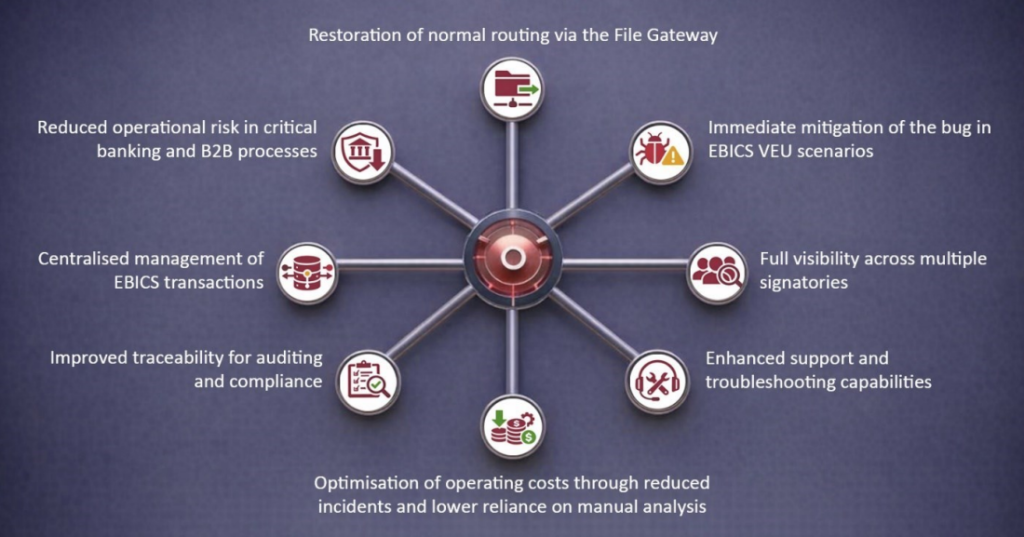
3.5. Benefits
3.6. Business impact (ROI)
EBICS Visibility & Routing Pack transforms EBICS operations into an agile, controlled and efficient model, reducing time, risk and costs from the outset. The combination of visibility, traceability and automation enables a shift from reactive management to a proactive and scalable operation.
Tangible results:
- 60% – 80% reduction in incident resolution time.
- 30% – 50% reduction in operational risk in critical processes.
- 40% – 60% decrease in escalations to IBM support.
- 50% – 70% acceleration in audit and compliance processes.
- 30% – 50% optimisation of operational effort (less manual dependency).
- 20% – 40% reduction in costs associated with incidents and support.
The result is a more efficient, reliable and scalable environment, contributing to greater resilience and a direct reduction in costs associated with incidents, support and operational management
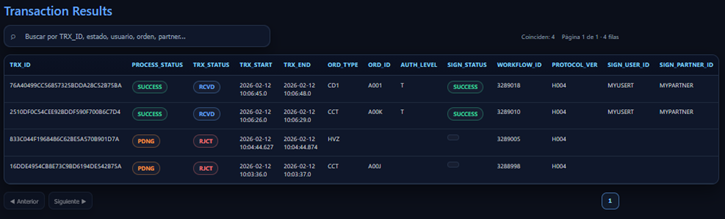
EBICS Visibility & Routing Pack: An EBICS transaction results dashboard that summarises the final status of each transaction, highlighting successful executions, rejections and key metadata for further analysis.
3.7. Use cases
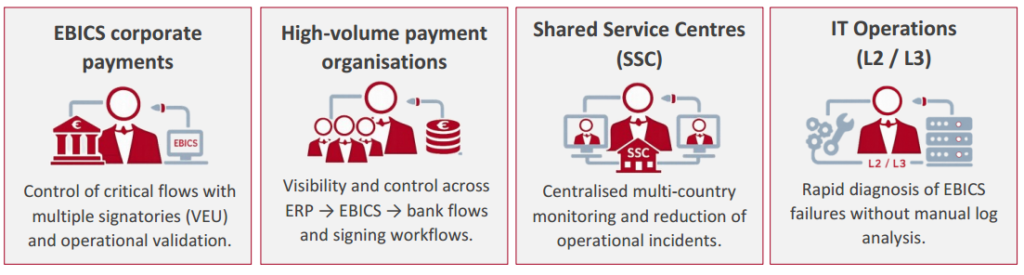
EBICS Visibility & Routing Pack: An EBICS certificate monitor that displays the status, validity and expiry dates of bank and partner certificates,
enabling the rapid identification of operational risks and renewal requirements.
3.8 Diferential value
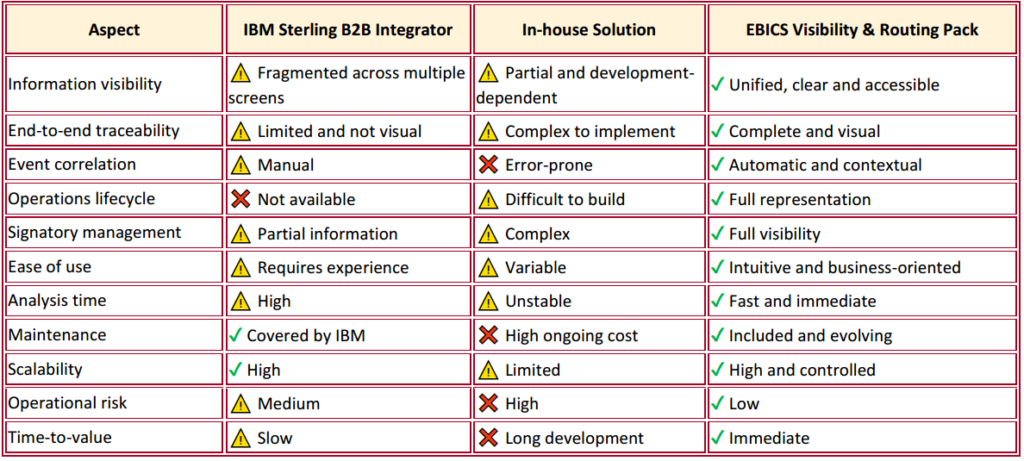
The IBM Sterling B2B Integrator environment is a robust platform for B2B communications and EBICS processes, offering high security, control and reliability in critical environments. However, it is geared towards technical operations rather than user experience or the efficient use of information.
On the other hand, developing in-house tools entails risks: ongoing maintenance, dependence on specific knowledge, lack of scalability and isolated solutions without a global view.
EBICS Visibility & Routing Pack addresses this gap: a professional, scalable solution specifically designed for Sterling, which enhances operations, auditing and control while avoiding the costs and risks of ad hoc developments.

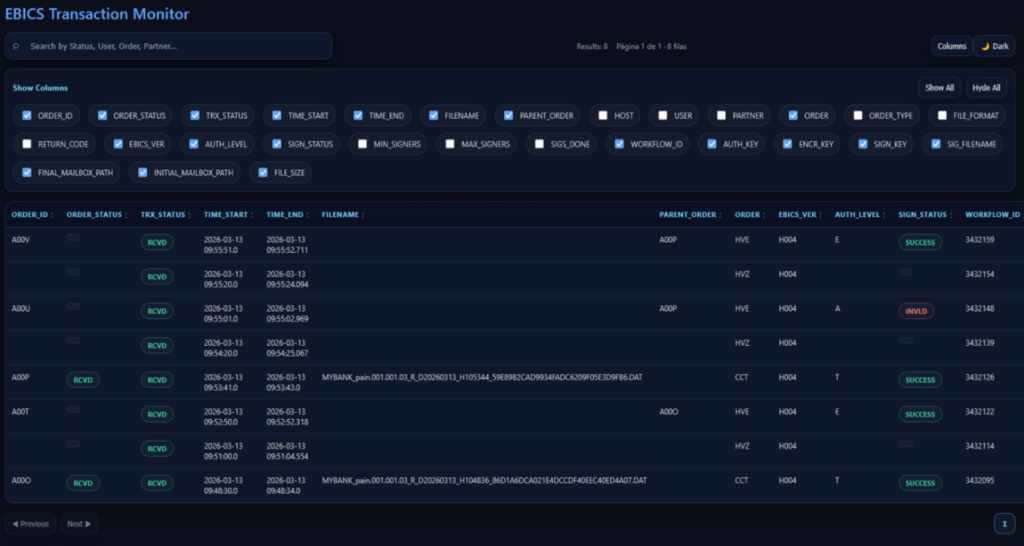
EBICS Visibility & Routing Pack: A detailed view of the EBICS transaction flow, showing each transaction along with its status, processing times and key metadata to facilitate tracking and monitoring of the entire process.

4. EBICS Server Certificate Monitor

In EBICS environments running on IBM Sterling B2B Integrator, certificate management is often fragmented, manual and heavily reliant on expert knowledge.
There is no native operational layer that allows for end-to-end management of the certificate lifecycle.
This creates a critical risk, which often goes unnoticed, within financial operations.
EBICS Server Certificate Monitor vides centralised visibility and proactive control over all EBICS certificates on IBM Sterling EBICS Server, enabling you to anticipate expiries, prevent disruptions and ensure operational continuity in critical financial communications.

4.1. The problem
The certificates used in EBICS connections (banks, partners, users):
- They are deployed across multiple configurations and systems.
- They are generated automatically, with unidentifiable names and no clear link to partners.
- They are difficult to monitor, with only partial visibility
- They lack proactive monitoring and centralised governance.
Operational teams rely on:
- Regular manual checks.
- In-house knowledge of specific configurations.
- Reactive troubleshooting when an incident occurs.
4.2. Impact on the business (what happens without the solution)
This operating model leads to recurring, high-impact incidents:
- Undetected time-outs that interrupt EBICS communications.
- Blocked payments in critical financial processes.
- Long incident resolution times (between 2 and 8 hours).
- Involvement of multiple teams (L2, L3, Security, Business).
- Heavy reliance on Sterling specialists.
Between 30% and 40% of critical EBICS incidents are related to certificates.
4.3. The Solution
EBICS Server Certificate Monitor adds an operational layer to IBM Sterling, transforming certificate management into a controlled, visual and proactive process.
The solution provides:
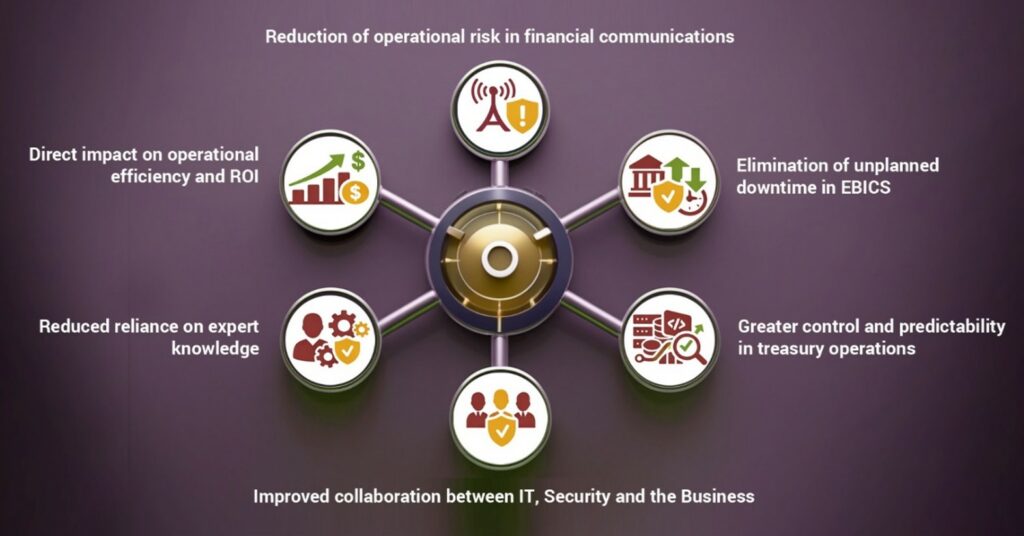
- Safer, disruption-free operations, avoiding interruptions in banking communications.
- Centralised control and visibility of all EBICS certificates, with key information for each certificate, including expiry dates.
- Automatic mapping between certificates and partners.
- Automatic identification of expiry risks.
- Full usage context (who, where, and for what purpose).
- Continuous monitoring with proactive alerts.
- Reduced operational risk in financial integrations.
4.4. Key Skills
- Unified EBICS certificate dashboard.
- Expiry tracking with automatic alerts.
- Centralised management across banks and partners.
- Elimination of manual checks.
- Operational visibility for IT, Operations and Security.
- Enables monitoring of:
- Bank certificates.
- Partner certificates.
- EBICS user certificates.
Certificates are no longer a blind spot but become a fully controlled asset.
4.5. Information available
EBICS Server Certificate Monitor displays key information for each EBICS certificate:
- Bank or partner organization.
- EBICS user.
- Key type (Signature, Authentication, Encryption).
- Certificate name.
- Valid from date.
- Expiry date.
- Current status.
- Days remaining until expiry.
4.6. Measurable Impact
Organisations that implement the solution achieve:
- Up to 70% fewer certificate-related incidents.
- Over 60% reduction in mean time to resolution (MTTR).
- Virtually no more outages due to expiry.
- Over 50% reduction in manual operational effort.
4.7. Benefits
4.8. Use cases
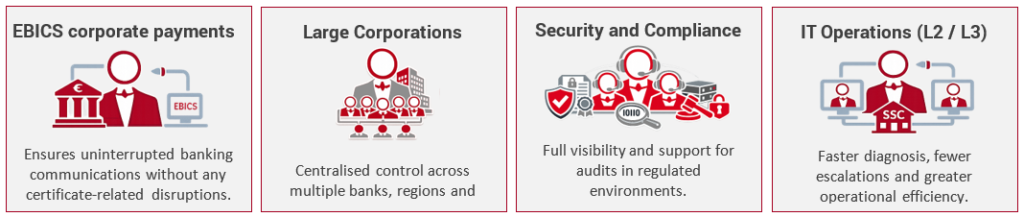
4.9. Why don not just use IBM or scripts?
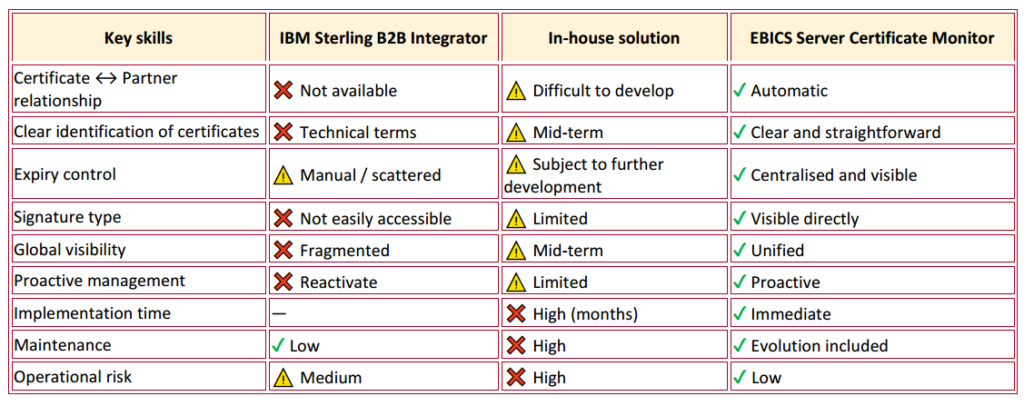
IBM Sterling (standard capabilities):
- Certificate information is fragmented.
- No operational lifecycle dashboard.
- Expiry control relies on manual processes.
- Troubleshooting requires a high level of technical expertise.
Scripts / in-house solutions:
- Limited scalability and maintainability.
- No unified data model or lifecycle view.
- High dependency on specific individuals.
- Partial coverage and lack of operational robustness.
EBICS Server Certificate Monitor:
- Centralised, production-ready operational dashboard.
- Integrated lifecycle management.
- Designed for operations, not just configuration.
- Demonstrable reduction in incidents and operational effort.
As a result, organisations operate reactively, identifying issues only after they have already impacted the service.
EBICS Server Certificate Monitor shifts this paradigm by introducing a proactive, centralised model focused on operational continuity.
The following comparison clearly illustrates this difference:
Without a dedicated operational layer, certificate management in EBICS remains a recurring and invisible risk.
EBICS Server Certificate Monitor eliminates this risk by providing:
• Visibility
• Control
• Foresight
Transforming a fragile process into a governed and predictable operation.
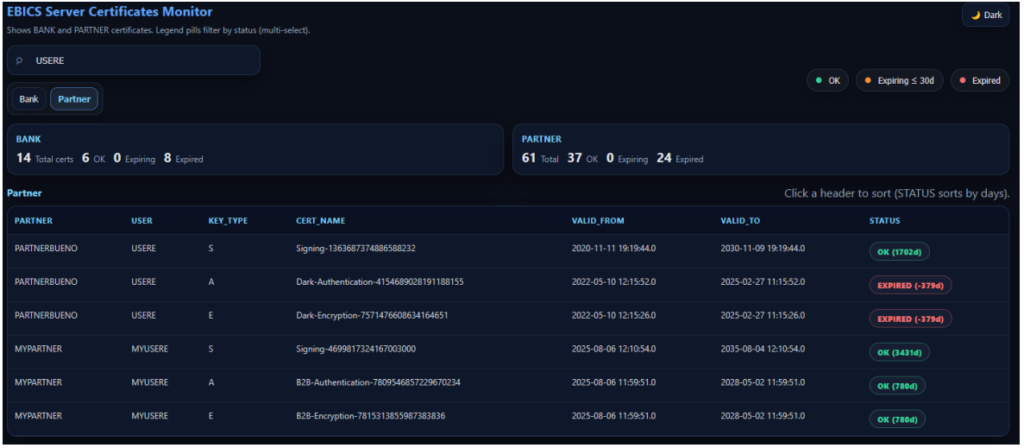
EBICS Server Certificate Monitor: Full control over the EBICS certificate lifecycle: early risk detection, visibility by partner, and elimination of operational blind spots.
5. Sterling Certificate Guardian

Digital certificate management is a critical component in any secure B2B information exchange environment. In platforms such as IBM Sterling B2B Integrator, where multiple connections, partners and communication channels coexist, the volume of certificates can grow rapidly and become a significant operational challenge.
Ensuring that all certificates remain valid and are properly managed is essential to maintain communication continuity, prevent incidents and ensure compliance with security standards. However, as environments evolve and increase in complexity, manual monitoring becomes inefficient, raising the risk of errors, unplanned disruptions, and increased operational workload for platform administrators.
Sterling Certificate Guardian is a dynamic dashboard designed to provide centralised visibility and control over all certificates within IBM Sterling, enabling organisations to anticipate expirations, prevent incidents and strengthen security across B2B communications.

5.1. The problem
In environments based on IBM Sterling B2B Integrator, the configuration and management of file collection processes via SFTP are often characterised by limited visibility, leading to several structural issues:
- Fragmented certificate information across different levels (system, trusted, CA).
- Difficulty identifying expired or soon-to-expire certificates.
- Dependence on manual reviews and non-standardised processes.
- High risk of disruptions to secure communications.
5.2. Impact on the business (what happens without the solution)
The impact is immediate:
- Disruptions: Connectivity failures with partners.
- Non-compliance: Contractual and regulatory risk.
- Operational overload: Increased workload for IT teams.
- Lack of control: Difficulty planning certificate renewals.
In sensitive environments, this not only affects systems, but also represents a direct operational and reputational risk to the business.
5.3. The Solution
Sterling Certificate Guardian provides:
- Centralised, comprehensive and real-time visibility: All certificates in a single location, regardless of their nature:
- Trusted certificates.
- System certificates.
- Private CA certificates.
- Expiration alerts: Identifies certificates that are close to expiry or already expired.
- Automatic calculation of remaining days until expiry.
- Classification by criticality and usage context.
- Advanced search and filtering across multiple dimensions (name, owner, dates, type).
- Prevention of incidents affecting secure communications.
- Scalability: Operates efficiently in large and complex environments.
- Centralised, comprehensive and real-time visibility: All certificates in a single location, regardless of their nature:
From an architectural perspective, the solution is designed for rapid and non-intrusive deployment, integrating with existing components without impacting operations or requiring changes to business workflows.
5.4. Benefits

5.5. Value proposition
Sterling Certificate Guardian transforms certificate management within IBM Sterling B2B Integrator by delivering visibility, control and proactive management capabilities across complex B2B environments.
The solution replaces manual and fragmented processes with a centralised and proactive management model, reducing operational risks, improving communication continuity and minimising dependency on specialist knowledge.
In addition, it strengthens governance and compliance, enabling organisations to operate with greater efficiency, security and operational maturity.
5.6. Use cases
5.7. Business Impact
Sterling Certificate Guardian directly impacts the stability, continuity and security of B2B communications, eliminating one of the main operational failure points: the lack of visibility and control over digital certificates.
In organisations without a specialised solution:
- Up to 35% – 45% of secure communications incidents are related to expired or poorly managed certificates.
- Identification and analysis of these issues can consume between
2 and 6 hours of manual work per incident. - Interruptions can directly affect critical business processes, partners and operational SLAs.
With Sterling Certificate Guardian:
- Up to 80% reduction in the time required to identify critical or soon-to-expire certificates.
- 70% – 90% reduction in incidents related to certificate expirations.
- Near-total elimination of unexpected disruptions caused by unmanaged certificates.
- Over 60% reduction in manual effort for monitoring, review and control tasks.
- Significant improvement in security and governance within the IBM Sterling B2B Integrator environment.
The impact goes beyond technical operations:
- Greater business continuity and resilience.
- Reduced costs associated with incidents and resolution times.
- Increased trust in the Sterling platform.
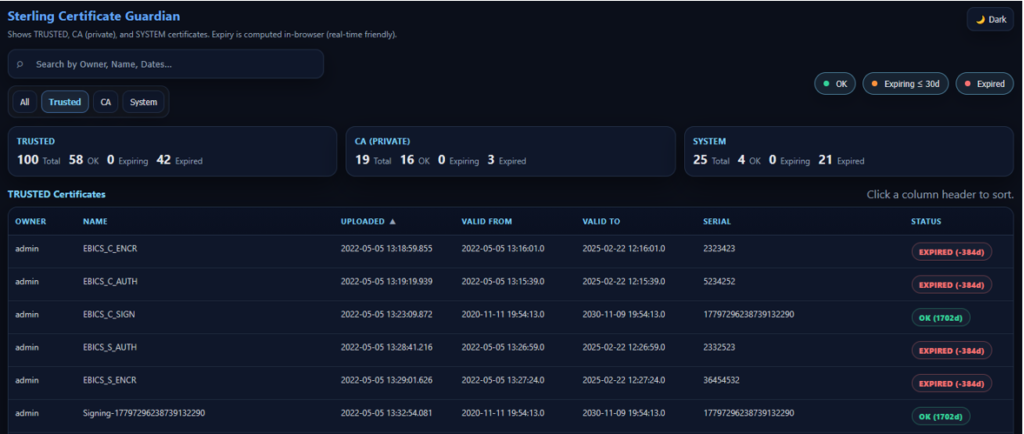
Centralised certificate view in Sterling Certificate Guardian, with classification by type (Trusted, CA and System), visual status indicators, and immediate detection of expired or soon-to-expire certificates. The solution provides real-time visibility, streamlines operational management and reduces the risk of disruptions in B2B communications.
5.8. Differentiating Value
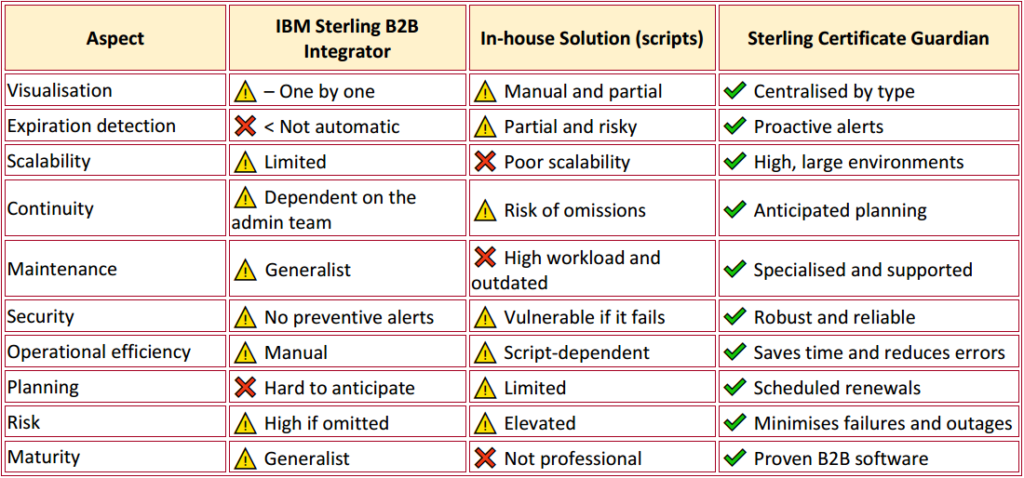
IBM Sterling B2B Integrator enables certificate visibility, but only at an individual level and without expiry alerts, making it difficult to manage environments with large numbers of certificates and to plan changes proactively.
Sterling Certificate Guardian centralises all information, displaying certificates by type (Trusted, CA and System) and highlighting those nearing expiration, enabling planning and ensuring operational continuity even in complex environments.
Attempting to replicate this functionality through in-house scripting requires skilled professionals and continuous maintenance, and does not guarantee the scalability or security provided by a specialised software solution. Our solution delivers maturity, reliability and proven efficiency.
The following table provides a clear comparative overview of functionalities, limitations and advantages between IBM Sterling B2B Integrator, in-house script-based solutions, and Sterling Certificate Guardian.

6. SFTP Feed Tool

In today’s B2B integration environments, the management of SFTP exchanges increasingly requires greater agility, traceability and operational control. However, many organisations continue to rely on complex technical configurations and inefficient operating models, particularly on critical platforms such as IBM Sterling B2B Integrator.
As the number of feeds, partners and exchange processes grows, it becomes increasingly difficult to maintain control, quickly identify incidents and ensure sustainable administration. Operations end up relying on specialist knowledge, multiple configuration points and processes that are difficult to monitor in a unified manner.
This situation not only impacts the technical area, but also the business’s responsiveness, resolution times and overall efficiency. The need to simplify, centralise and provide real visibility over SFTP flows becomes a key factor in improving governance and reducing operational cost.
SFTP Feed Tool simplifies and speeds up the configuration, control and monitoring of SFTP data collections in IBM Sterling B2B Integrator, enabling you to operate more efficiently, reduce errors and improve control over your integrations.

6.1. The problem
In IBM Sterling B2B Integrator-based environments, the configuration and management of file retrieval
via SFTP typically involves:
- Transfers distributed across multiple interdependent technical components (partners, routes, processes. and related elements).
- Fragmented and non-intuitive management.
- Difficulty in understanding the end-to-end flow.
- Low end-to-end traceability.
- Dependence on technical profiles.
- Slow incident diagnosis.
6.2. Impact on the business (what happens without the solution)
This leads to a direct impact on operations:
- Increased operational complexity.
- Longer resolution times.
- Higher risk of human error.
- Lack of true process visibility.
- Higher operational costs.
- Limited agility in the face of changes or new integrations.
In environments with multiple feeds and partners, this complexity becomes an operational bottleneck, limiting efficiency and increasing the risk of incidents.
6.3. The Solution
SFTP Feed Tool is an application designed to provide an intuitive, structured and operations-oriented approach.
Through a simplified interface, users can:
- Configure new file retrievals quickly and in a guided manner.
- Enable or disable processes according to operational needs.
- Reuse existing configurations to accelerate deployments.
The tool also incorporates a real-time monitoring system, which enables users to visualise the status of feeds and detect incidents immediately.
One of its key differentiators is the capability for detailed phase-based process analysis:
- Begin.
- Get.
- Delete.
This, together with workflow-level detail, enables precise identification of where an error occurs, significantly reducing diagnosis time.
In addition, the solution provides execution metrics that facilitate performance tracking and continuous process optimisation.
From an architectural perspective, the tool is designed to integrate naturally with IBM Sterling B2B Integrator, without the need for complex developments or impact on existing flows.
Overall, SFTP Feed Tool transforms a traditionally technical and costly process into an agile capability that provides:
- Centralised configuration in a single point.
- Removal of the complex partner-based model.
- Phased transmission visibility (detailed control).
- Full end-to-end monitoring.
- Simplified access for business and operations.
- Fast and accurate diagnosis.
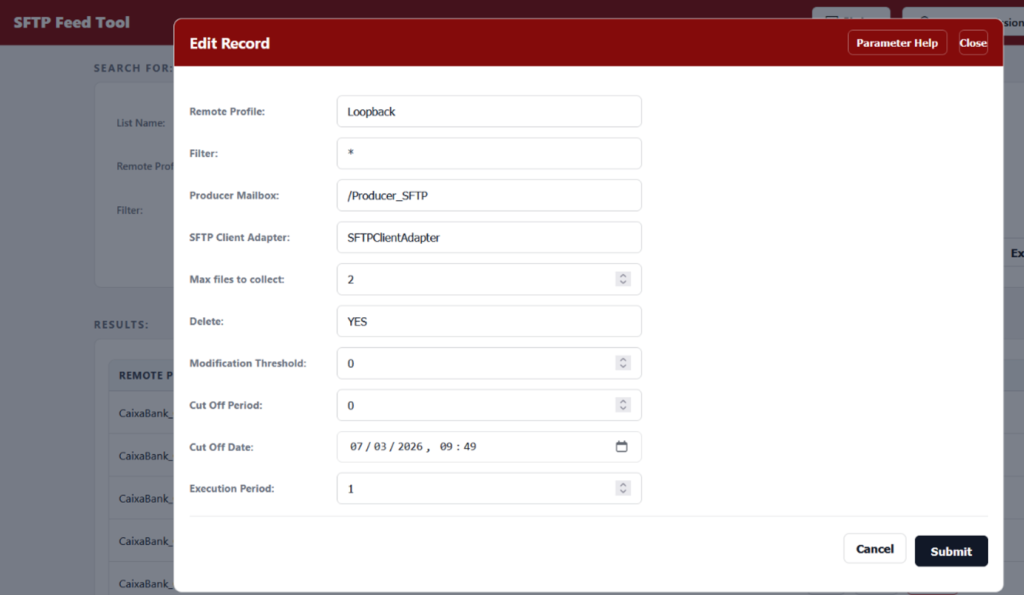
SFTP feed configuration screen where operational parameters are defined, such as remote profile, target mailbox, SFTP adapter, maximum number of files, deletion policies and execution frequency. The tool enables detailed control of process behaviour, with a simplified, operations-oriented user experience.
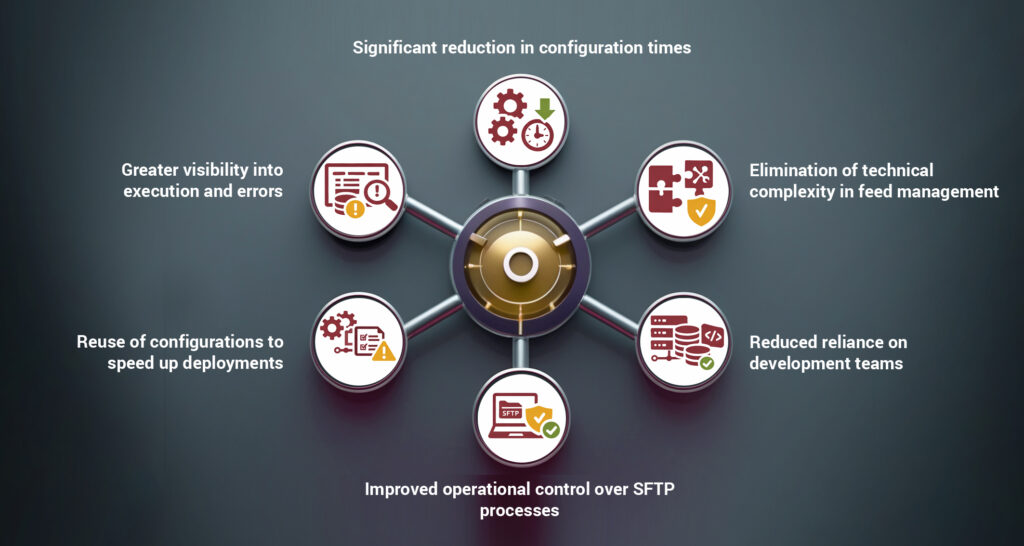
6.4. Benefits
6.5. Value proposition
SFTP Feed Tool radically simplifies the management of SFTP integrations within IBM Sterling B2B Integrator, replacing a complex, highly technical model with a centralised, standardised and operations-oriented approach.
It enables feed management to move from technical teams to operational profiles, reducing dependency, errors and response times.
In addition, it provides greater consistency across configurations and establishes a scalable foundation for environments with a high volume of integrations.
Ultimately, the tool transforms SFTP management into a more agile, governed and business-aligned process, freeing up technical resources and improving the overall efficiency of the platform.
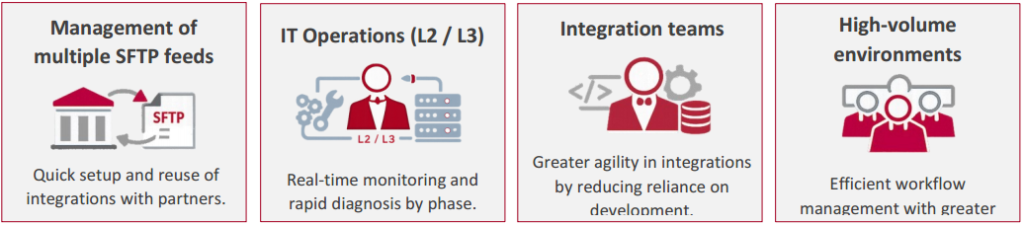
6.6. Use cases
6.7. Business Impact (what happens without the solution)
In traditional models, SFTP operations are characterised by high technical complexity and strong dependence on specialist profiles:
- The configuration of a new feed can take between 4 and 16 hours, depending on the complexity of the flow and the team’s level of expertise.
- Incident analysis and resolution may require between 1 and 3 days in non-optimised environments, due to the need for manual review across multiple components.
- Configuration errors generate rework cycles that can increase operational effort by an additional 20%–35%.
- The lack of end-to-end visibility complicates diagnosis and extends service recovery times.
With SFTP Feed Tool, this model evolves into a more efficient and controlled operational approach:
- 50%–70% reduction in configuration times, moving from hours to minutes in most standard use cases.
- 60%–80% decrease in configuration errors, thanks to process standardisation and centralisation.
- Reduction in incident diagnosis time of up to 40%–60%, through phase-based visibility (Begin / Get / Delete).
- Significant reduction in dependence on specialist technical profiles, shifting operations towards functional teams.
- Overall operational cost optimisation of between 25%–40%, by reducing rework, incidents and support effort.
Overall, the solution not only improves process efficiency, but also introduces a more predictable, controlled and scalable operating model, aligned with the demands of critical integration environments.
6.8. Differentiating Value
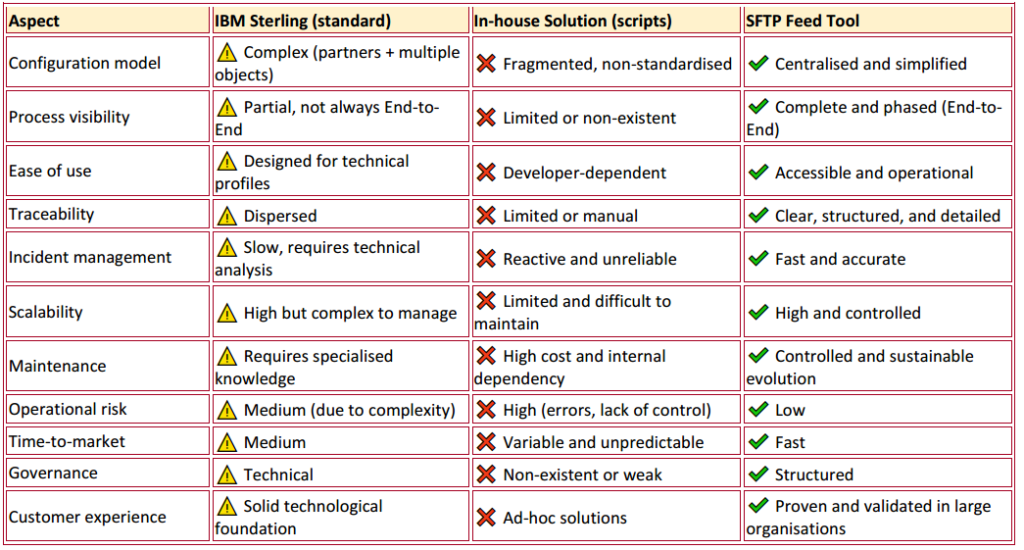
The management of SFTP file retrievals within IBM Sterling B2B Integrator is primarily focused on technical configuration, which introduces complexity and dependence on specialist profiles.
SFTP Feed Tool’s ability to combine simplicity, monitoring and detailed diagnosis makes it a distinctive solution compared with traditional approaches or costly bespoke developments.

Communication
If you need more information about our solutions,
please feel free to contact us.
We will be happy to answer your questions: